
This week, I sat down with Harry Wilkinson to talk about his experiences as a newcomer to the label production business and how he found his way around the complicated world of labels. Harry’s journey shows how the industry works and what new trends are coming up. He makes surprising finds and learns important lessons along the way.
It wasn’t so much labels that attracted me to Hine, initially… I was looking to leave the recruitment industry and needed a fresh challenge. When I was searching for jobs, it became very apparent that we live in such an industrious area and most of my friends and family are involved in some form of manufacturing, and it felt like the right decision for me to join a company with a rich history, where I could essentially start from the bottom and work my way up. Hine presented that opportunity, and after my initial research and interview process – I knew it was the right fit!
Massively so. Before you’re involved in any form of print company, you kind of skip through life not noticing print or labels, or really understanding their true purpose. Now, I have great respect for all forms of print.
I think as time’s gone on; nothing really surprises me anymore… But I think naively, when I first joined, I hadn’t really grasped just how much influence external factors can play on our daily operations. At University, you’re taught a rough version of raw material + process = money, but when you’re in the bubble, you see how things like substrate, inks, tooling, couriers, and everything else in between can affect any number of jobs, and really, there isn’t much you can do about it. I will add, thankfully, we have some excellent suppliers who do all they can for us.
Initially, the main challenge was technical understanding, or ‘print knowledge,’ as I’d never seen it before. To overcome that, I’ve spent time in all areas of the business to soak up as much information and knowledge as possible, and I continue to work closely with Tom Gould, and Bill (our CEO), who is undoubtedly the messiah of labels.
It’s easy for me to just say I’m driven and want to achieve the best in everything I do. I think the real reason I’ve established credibility is because I have a team around me that I am very grateful for and who I know I can trust to play their part in the customer’s journey. It’s very easy to sit in a room and sell Hine Labels, when I know the team will do whatever it takes to support me. It gives you the license to sell with confidence. I also continually ‘bang on about’ consistency, and it’s something I push in everything we do. Examples would be the social media output on LinkedIn has remained very consistent, therefore, we are seeing excellent follower/interaction results. We remain consistent in checking in on loyal customers and asking about repeat work, not just so we receive an order ‘earlier,’ but so it may help us manage the end-user’s lead-time expectations. The better we are as a supplier, the more credible and distinguished we’ll become.
There are so many key parts to bringing a label to life from concept to shipment. From a pre-press department perspective, you realise how intricate margins, edge lead & safe areas, etc., can be. From a printing point of view, you see how vital being proactive and being prepared goes a long way to building an efficient production flow. We can minimise lead time and help manage customer expectations better by ensuring the factory has everything necessary to get the job out the door in both a timely manner and without sacrificing quality.
It’s been a pleasure meeting with various people in the industry and, of course, working alongside some very experienced professionals. It has most definitely enhanced my understanding and knowledge and has certainly shaped my approach moving forward.
Peel and Reveal multi-layer labels are very exciting and something we’ve most definitely nailed here at Hine Labels with a brand new process. With the ever-growing legislation in various industries, we understand that end-users don’t want to sacrifice their brand image on the face of their label, so instead, legislative information is on a second layer, accessible if required. It’s a very good solution and one we’re happy to produce with confidence.
As a trade label supplier, we know that usually our customers aren’t the end users. So having constant contact with our customer means the message can be sent ‘down-the-line’ and hopefully manage expectations as best we can. Things go wrong in manufacturing, but we’re not scared of that. We’re honest and explain when issues occur and, of course, take the necessary steps to resolve them. That will undoubtedly set you apart, as it shows you care and respect both your customer and their end user, too.
Initially, as a Client Account Manager, my role was to support the customer service team to nurture existing accounts. From there, I have learnt how to produce estimates for digital print work through our MIS and, of course, grown into my new role as Business Development Manager, where my focus has now shifted to increasing the number of new accounts by implementing a new sales strategy to support our marketing efforts.
I would say, be confident in your existing knowledge from previous roles and education. As there are lots of transferable skills from an all-round business perspective. From there, you will have strong foundations to increase your technical knowledge and understanding. Surround yourself with experienced professionals and ask as many questions as possible. Before you know it, you will have the confidence to grow with your company or within the industry.
I see my future here at Hine Labels and hope, as the business grows, I follow. Taking on more responsibility operationally and driving the commercial side of the business. There is certainly a buzz at Hine, and I’m excited for what the short-term and long-term will bring for us all, as a team. Within the industry, I think you want to be known as a reliable, trustworthy professional—so if I can leave that mark, that would be great, too!
This week is #NationalApprenticeshipWeek, so I sat down with our Tom Gould to talk about his own apprenticeship.
Tom started out as an apprentice at Hine Labels nine years ago. Since then, he has stayed with the company and worked in a number of skilled roles in different parts of the business.
We went back in time to reflect on where he began and where he is now.
Randomly. I wasn’t looking for it; I was looking for a job, so I think it was on Indeed.com or another job-hunting site when I saw Apprenticeships as an option.
I’d already done my A-Levels in Maths, Geography, and Geology at Thomas Rotherham College, and I’d started studying Public Services at Dearne Valley College.
I wasn’t enjoying the Public Services course, it wasn’t something I really wanted to do. After studying Maths at A-Level, I couldn’t go to University, but I would have loved to study and gain a Bachelor of Science in Mathematics.
It was for 2 years, starting in the warehouse. I eventually moved into the Finishing department, running our very first A B Graphic International Digicon machine. It did varnishing, laminating, and die cutting.
At the time, starting an apprenticeship was a way of getting paid while also studying. I wasn’t sure if an apprenticeship was for me but, once I started and I was here, it felt like I’d arrived at the right place. I’d made the right choice.
I completed a Level 2 course in Warehousing and Storage. A tutor would regularly visit to check on my progress so, one day, I asked him what usually happens when an apprenticeship ends. I’d heard horror stories of apprentices being used as cheap temporary labour, but Hine wasn’t like that – I was offered the job I had already learned and enjoyed, and that made me feel secure in a company I really liked working with.
Later, I was given the opportunity to work in the Customer Service office, and I held that role for about 3 years. It was something new to try, and I was able to apply some of the knowledge I’d gained from working in the factory. I was glad for the opportunity, and the training provided was great. I remember having customer service training with Lee Marlow from Astrum Business Transformation, which was really good. I felt like I was invested in.
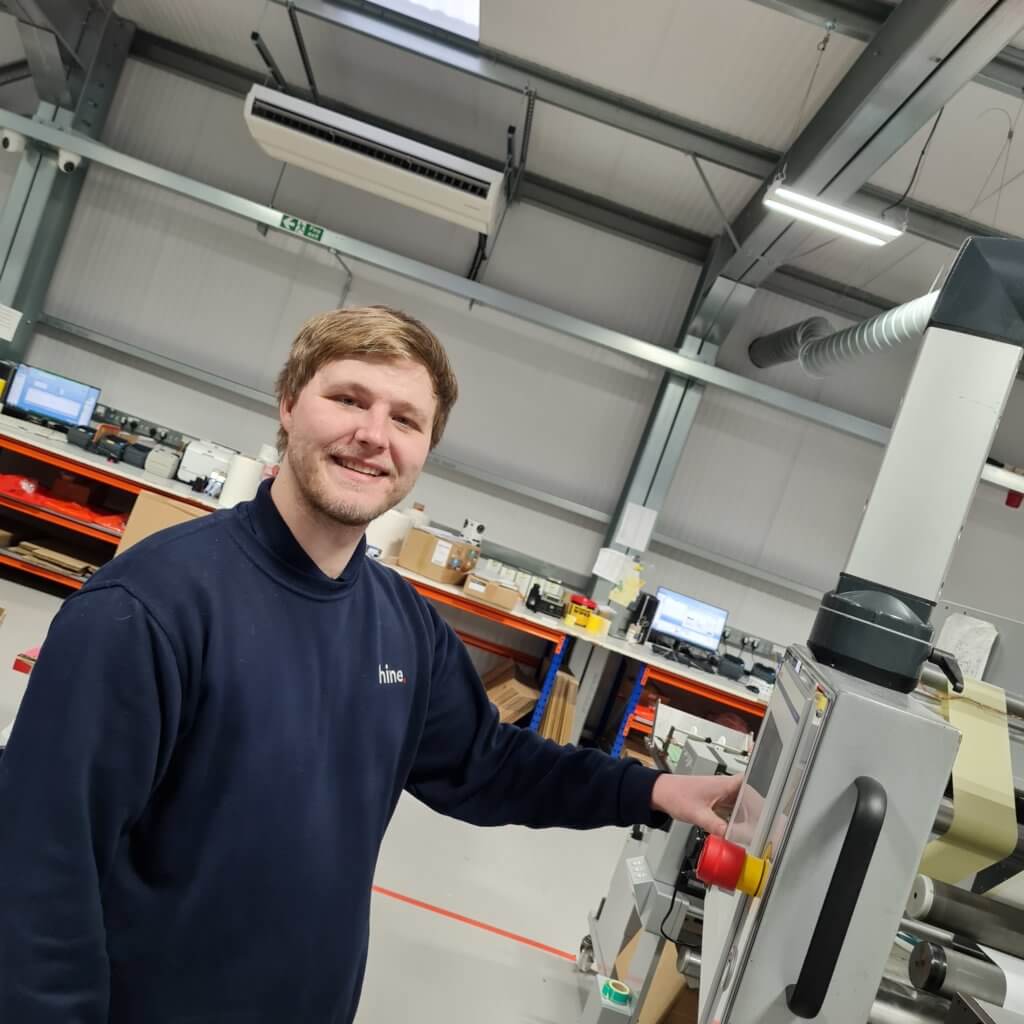
I’m back in the factory and have been there for the last few years. It’s where I am most suited and feel at home! We have more finishing machines like the one I used to operate, but they are obviously more advanced now, and they all do slightly different things, so there’s always skills to hone. I like working with my hands.
It’s a small family-owned business, so you don’t feel like you’re just a number. I have friends who work at big national companies, and they don’t have that personable family-feel, they don’t experience the culture I get to work in. Everybody is nice and supportive at Hine, and I feel recognised – I think that’s the best thing.
I love that I have become multi-skilled. My primary role is Label Finishing, but I’ve had opportunities to train on our bigger Digicon Series 3, which does all our premium label embellishments such as foil, multi-layer label conversion, and high-build textured varnishes.
I was included in the new training for our SCREEN Europe Truepress digital printing press in the second half of last year, so that’s something else I’ve been able to develop in my skillset.
Yes, definitely! Obviously, it’s not for everybody, but the same is said that university isn’t for everybody. People learn in different ways – I found the best fit for me. Nine years ago, I could not have imagined I’d be where I am now. Doing an apprenticeship was my best start, and I found the opportunities to succeed.
If you or somebody you know would like to become an apprentice, check out the Gov.uk website, Become an apprentice
If you have a company wanting to invest in the future of somebody like Tom, check out Employing an apprentice